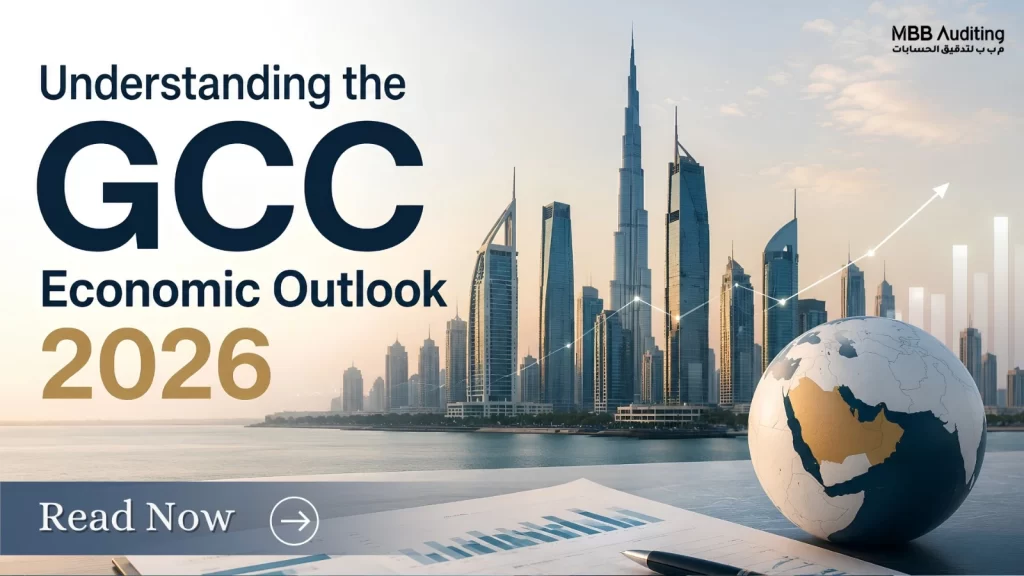
Understanding the GCC Economic Outlook 2026

A new chapter of growth is unfolding in the GCC. The 2026 outlook reflects a region transitioning from oil dependence to a more diversified, tech-enabled future. Despite global headwinds and market volatility, sustained reforms and digital acceleration are reinforcing economic resilience.
For leaders, the focus is clear: move beyond risk management and unlock opportunities that drive lasting value.
Let’s explore the key trends shaping the GCC outlook in 2026:
Economic Shift: From Expansion to Execution
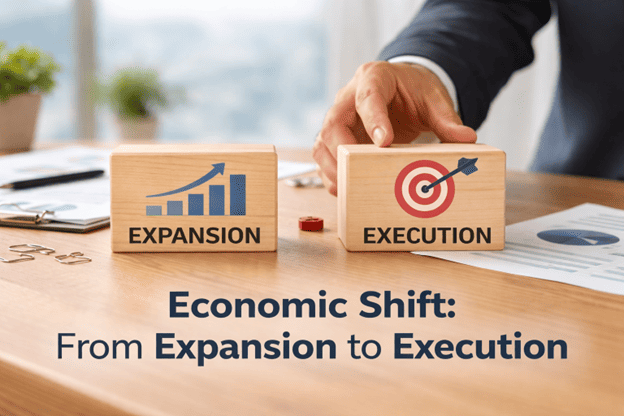
The GCC’s focus is shifting from announcing big plans to delivering real results. In 2026, governments are prioritising execution across key sectors such as infrastructure, logistics, and technology.
For instance, large-scale logistics investments-including multi-billion-dollar warehouse and supply chain platforms across the Gulf-are translating diversification plans into operational assets, while targeted programs in countries like Qatar are actively channeling funding into advanced industries, fintech, and AI-driven ecosystems. At the same time, continued rollout of transport networks, urban infrastructure, and industrial corridors is reinforcing the region’s ambition to become a global trade and logistics hub.
This reflects a maturing economy where outcomes matter more than outlays. For business leaders, it means tighter accountability and a stronger emphasis on ROI-driven, execution-led growth.
The Role of AI and Digital Transformation
AI is redefining how businesses compete in the GCC. By 2026, the shift is clear away from experimentation and toward full-scale, results-driven implementation. Organisations are focusing on high-ROI applications, with AI increasingly embedded into core functions and decision-making processes. Supported by rapid investments in digital infrastructure, sectors across the region are accelerating adoption. Yet, the real differentiator lies in execution, combining technology with the right talent, governance, and vision. In this new landscape, AI isn’t just an enabler; it’s the engine of growth.
How AI Transforms Businesses
AI is enabling organisations of all sizes, from startups to large enterprises, to modernise and reinvent traditional processes. Whether applied to small projects or full-scale digital transformation, AI offers powerful capabilities such as:
- Customer service automation: AI-powered chatbots and virtual agents handle routine and complex queries, reducing the workload on human support teams.
- Demand forecasting: Advanced models analyse historical data, seasonal patterns, and market trends to accurately predict demand for products or services.
- Predictive maintenance: AI systems connected to machinery or vehicles monitor performance in real time, detect anomalies, and anticipate potential failures.
However, not every organisation achieves success. Many struggle because they implement AI too quickly or without fully understanding where and how it delivers the most value.
Trade Diversification and Global Positioning

A new era of trade is taking shape in the GCC. In 2026, diversification is no longer optional-it’s strategic. As geopolitical shifts reshape global commerce, the region is forging stronger ties with key markets and investing in future trade corridors. The result is a more resilient, connected, and forward-looking economic model.
For businesses, success will depend on how quickly they adapt to these changing trade dynamics and position themselves within new value chains.
Examples of GCC trade deals, partnerships, and key initiatives:
- Extending Trade Reach Across New Global Corridors
GCC nations are diversifying trade amid US-China tensions, with initiatives like IMEC and the UAE’s CEPA boosting global integration. - Enhancing Stability in Critical Mineral Supply Chains
Rising demand for critical minerals is pushing nations to build resilient supply chains beyond China’s dominant processing network. The GCC, led by Saudi Arabia and the United Arab Emirates, is investing in mining, refining, and global partnerships to become a key link in future supply chains. - Turning AI Potential into Measurable Results
Rising demand for AI computing power is driving the United Arab Emirates, Saudi Arabia, and Qatar to invest heavily in GPUs and data centres. With stronger infrastructure and regulations, 2026 will bring large-scale AI adoption and position the GCC as a global innovation hub. - Reshaping the Workforce for an AI-Enabled Economy
Slower productivity growth in the GCC is creating urgency to use AI for efficiency. Governments are prioritising reskilling, talent development, and public-private partnerships to support an AI-driven economy. - Bolstering Economic Stability Beyond Oil Dependence
With oil prices expected to be around $55-60, GCC economies face tighter budgets, accelerating privatisation, PPPs, and non-oil revenue reforms to enhance long-term resilience.
Key strategic considerations for leaders and decision-makers in 2026

The GCC Economic Outlook 2026 delivers a clear message: success will be defined by adaptability and innovation. Leaders must move beyond traditional business models and accelerate digital transformation, strengthen strategic partnerships, and embed data-driven decision-making at the core of their operations.
Rather than reacting to change, leading organisations will anticipate it, leveraging AI, expanding into new markets, and building resilient, future-ready operations. Ultimately, the ability to align business strategies with regional economic priorities will be critical to achieving sustainable, long-term growth.
Key priorities for leaders:
- Drive strategic diversification: Expand beyond traditional sectors by exploring new markets, services, and global value chains.
- Scale AI with purpose: Move beyond pilots to embed AI into core operations, supported by strong governance and measurable outcomes.
- Invest in workforce transformation: Prioritise reskilling and equip teams to operate effectively in a digital, AI-enabled environment.
- Link technology to value creation: Ensure innovation delivers tangible outcomes that enhance the customer experience, improve efficiency, and unlock new revenue streams.
How MBB Auditing Supports Your 2026 Strategy

At MBB Auditing, we help businesses navigate the GCC Economic Outlook 2026 with confidence by strengthening financial governance, ensuring tax compliance, and optimising cost structures for sustainable growth. Our expert advisory enables CEOs and CFOs to make data-driven decisions, manage risk effectively, and align their operations with the region’s evolving regulatory and economic landscape.
Conclusion: Turning Outlook into Opportunity
In conclusion, the GCC Economic Outlook 2026 presents a balanced mix of challenges and opportunities. While short-term uncertainties may impact growth, the region’s strong push toward diversification, digitalisation, and innovation creates a powerful foundation for the future.
For tech and business leaders, this is a defining moment. Those who act strategically-investing in technology, talent, and global expansion-will not only survive but thrive in the next phase of the GCC’s economic evolution.