

The FTA issued the public clarification CTP010 – Clarification of director and officer on 29 April 2026, with effect from the implementation date of the UAE Corporate Tax legislation, providing important guidance on the interpretation of “connected persons” under the UAE Corporate Tax Law, particularly in relation to the definitions of “director” and “officer.”

Understanding the Rules Issued to Date
To better understand the current position, it is important first to review the rules and guidance issued to date in relation to the concept of connected persons under the UAE Corporate Tax Law.
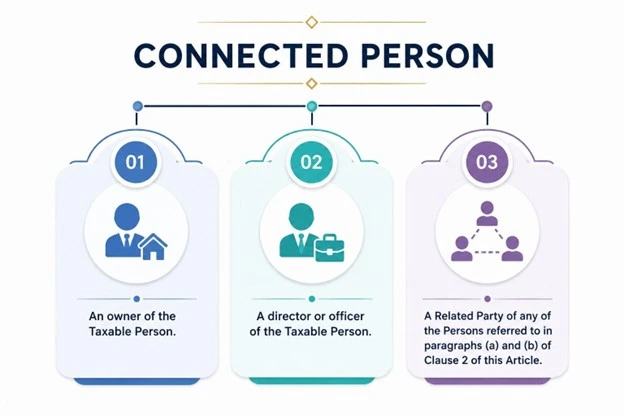
Pursuant to Article 36 of Federal Decree-Law No. 47 of 2022 on the Taxation of Corporations and Businesses, a person shall be considered a Connected Person of a Taxable Person if that Person is:
- An owner of the Taxable Person.
- A director or officer of the Taxable Person.
- A Related Party of any of the Persons referred to in paragraphs (a) and (b) of Clause 2 of this Article.
The Connected Person provisions under the UAE Corporate Tax regime result in increased scrutiny of transactions involving owners, directors, officers, and their related parties. Such transactions are generally expected to be undertaken on arm’s length and commercial terms, with taxpayers required to demonstrate that the expenses incurred are wholly and exclusively for business purposes.
Further, where the aggregate value of transactions with Connected Persons exceeds AED 500,000 during a tax period, the taxpayer is required to submit a Connected Person Transactions Disclosure as part of its Corporate Tax compliance obligations.
Failure to appropriately identify, support, or disclose such transactions may result in tax adjustments, disallowance of deductions, penalties, or additional scrutiny from the Federal Tax Authority.
Analysing the Public Clarification CTP010

For months, UAE businesses navigating the Corporate Tax regime have been wrestling with a deceptively simple question: who, exactly, counts as a “director” or “officer” for Article 36? The Federal Tax Authority (FTA) has now answered that question through Public Clarification CTP010, issued in April 2026. And its answer is far more nuanced – and consequential – than many might have expected.
Decoding the FTA’s Definition of a Director
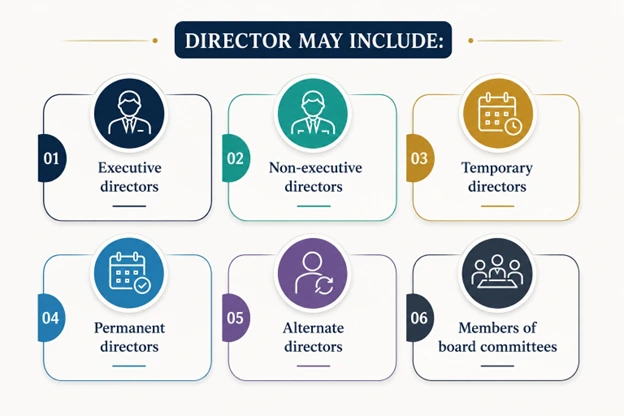
A director typically means a person appointed to the board of directors or to any comparable governing body of a Taxable Person. The clarification confirms that the definition is not restricted to executive directors and may extend to various persons formally holding board-level or equivalent governing positions.
This may include:
- Executive directors
- Non-executive directors
- Temporary directors
- Permanent directors
- Alternate directors
- Members of board committees
If the entity lacks a formal board structure, the term may also apply to individuals carrying out equivalent management or governing responsibilities, depending on the relevant legal framework and the entity’s governing documents. Examples may include Board of Trustees, and Board of Governors.
The assessment is generally based on the applicable law and the entity’s constitutional documents, including Memorandum of Association, Articles of Association, Partnership deed, and Trust deed.
The clarification under CTP010 also emphasises that the presence of the title “director” in an employee’s designation alone is not sufficient to treat that individual as a director for Article 36. A person will generally only be regarded as a director where they formally hold a position on the board or equivalent governing body. However, it may still be necessary to separately assess whether such an individual could qualify as an “officer.”
Decoding the FTA’s Definition of an Officer
An officer is generally an individual who exercises substantial control and authority over the strategic direction and key operations of a business, including financial, operational, and commercial matters, in line with the principles of IAS 24 (Related Party Disclosures).
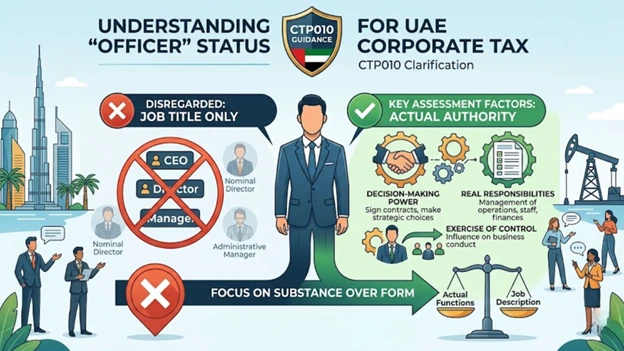
Such individuals typically:
- Participate in directing and overseeing the entity’s core business activities
- Hold the authority to make significant decisions or approve actions on behalf of the entity
- Have the power to enter into commitments or legally binding arrangements for the business
Officer positions may include roles such as Chief Executive Officer (CEO), Chief Financial Officer (CFO), Chief Operating Officer (COO), General Manager (GM), or other individuals with ultimate decision-making responsibilities.
Nevertheless, CTP010 highlights that job titles alone are not conclusive. The actual authority and responsibilities performed by the individual take precedence over the title itself. As a result, a person with a senior designation but without final decision-making authority would generally not qualify as an officer for Article 36 purposes.
Let’s explore this through a few practical examples:
A head of division may be regarded as an “officer” where they possess ultimate authority to make strategic decisions relating to the financial, operational, or commercial affairs of the Taxable Person.
However, if the individual only operates within guidelines established by the C-suite, board of directors, or a similar governing body, and merely implements or reports on decisions without having final decision-making authority, they would generally not qualify as an “officer.”

Employees, secondees, or outsourced management personnel would generally not be treated as “officers” where their role is limited to finalising contractual negotiations after the key commercial and legal terms have already been approved.
However, such individuals may be considered “officers” if they hold ultimate authority to make strategic decisions or have the power to enter into agreements that legally bind the Taxable Person.
Linkage of IAS 24 Related Party Disclosures with the Public Clarification
IAS 24 treats directors, key management personnel (“KMP”), and their close family members as part of the broader related party framework for financial reporting purposes. Under IAS 24, KMP are defined as persons having the authority and responsibility for planning, directing, and controlling the activities of the entity, directly or indirectly.

CTP010 adopts similar underlying principles when assessing who may be considered an “officer” for UAE Corporate Tax purposes. In particular, the clarification focuses on the actual authority, responsibilities, and decision-making power exercised by an individual, rather than merely their job title.
However, there is an important distinction between the two frameworks. While IAS 24 groups directors and key management personnel within the broader concept of related parties, the UAE Corporate Tax regime separates these concepts into distinct categories. Under Article 36, directors and officers are treated as Connected Persons, whereas Related Parties are defined separately under the Corporate Tax Law. As a result, CTP010 provides specific guidance on identifying directors and officers for Connected Person purposes, rather than treating them solely as part of a broader related party analysis.
Accordingly, although the assessment criteria used in CTP010 are broadly consistent with the IAS 24 concept of Key Management Personnel, the Corporate Tax consequences arise under the Connected Person provisions rather than the Related Party provisions.
Navigating Practical Challenges and Considerations
Practical Challenges
One of the main practical difficulties for businesses is determining which individuals should be treated as an “officer” for Corporate Tax purposes.
Potential risk areas commonly include:
- Senior management personnel below board level who possess substantial operational or decision-making authority
- Individuals granted extensive powers of attorney, especially where they are authorised to approve or execute transactions on behalf of the business, even if they do not hold an official management title
- Temporary, interim, or outsourced management personnel
- Family-owned or closely controlled businesses where decision-making responsibilities may not be formally documented
In these situations, the lack of an official designation or title does not automatically exclude an individual from being regarded as an “officer.”
Business Compliance Recommendations
Businesses in the UAE should carefully assess their Connected Persons and related payment arrangements before submitting their Corporate Tax Return.
This review should involve identifying individuals who hold ultimate decision-making authority or the power to legally bind the business, evaluating whether payments or benefits provided to such individuals reflect Market Value, considering the applicability of any exemptions under Article 36, and ensuring adequate documentation is maintained to support both deductibility and disclosure requirements.
How We Support You

MBB Auditing assists businesses in understanding CTP010 and strengthening Corporate Tax and transfer pricing compliance by identifying related parties, reviewing governance structures, assessing payments to key personnel, benchmarking remuneration, ensuring accurate tax disclosures, and improving transfer pricing documentation and internal processes.
FAQs:
- Who is considered a Connected Person under the UAE Corporate Tax Law?
Under the UAE Corporate Tax regime, a Connected Person may comprise an owner, director, officer, or a Related Party of any such person in relation to a Taxable Person. - How can a business determine whether an individual qualifies as an “officer”?
The assessment depends on the individual’s actual authority and responsibilities, particularly their ability to make strategic decisions or legally bind the business, rather than their job title alone. - Are payments made to Connected Persons deductible for Corporate Tax purposes?
Yes, but only to the extent that the payments or benefits are at Market Value and incurred wholly and exclusively for business purposes under Article 36. - When is disclosure of Connected Persons required in the Corporate Tax Return?
Disclosure is generally required when the total value of payments or benefits provided to Connected Persons exceeds AED 500,000 during the relevant tax period. - What documentation should businesses maintain for Connected Person transactions?
Businesses should retain agreements, approvals, market value assessments, supporting calculations, and other relevant records to justify deductibility and comply with disclosure obligations under the UAE Corporate Tax Law.
Conclusion
CTP010 makes one thing clear: titles alone do not determine a person’s treatment under the UAE Corporate Tax regime. Simply having “Director”, “Head”, “Manager”, or another senior-sounding designation does not automatically make an individual a Connected Person. Instead, the analysis focuses on the individual’s actual role, responsibilities, and level of authority within the organisation.
Similarly, key management personnel are not automatically regarded as Connected Persons. While the concepts may overlap, the determining factor is whether the individual exercises the level of governance, management, or decision-making authority contemplated by the Corporate Tax Law and the clarification. As a result, a substance-over-form approach should be applied when assessing an individual’s status.
CTP010 also clarifies the interaction between the Related Party and Connected Person provisions. Where a person qualifies as both a Related Party and a Connected Person, the Related Party provisions take precedence, and the person will be treated as a Related Party for Corporate Tax purposes. This distinction is important, as different compliance and disclosure requirements may apply depending on the applicable classification.