

Artificial Intelligence (AI) is reshaping the way businesses operate across the Middle East. What was once seen as a future technology is now becoming a key part of everyday business activities. From healthcare and banking to retail, logistics, and government services, organisations are using AI to improve efficiency, make smarter decisions, and create better customer experiences.
As AI adoption continues to grow, businesses across the region are moving beyond experimentation and focusing on real-world results. The Middle East is rapidly emerging as a hub for AI-driven innovation, supported by strong government initiatives and increasing investment in digital transformation.
This blog explores how AI is influencing industries across the region, the opportunities it is creating, and what businesses need to do to stay ahead in this new era of intelligent technology.

The Role of Government in Shaping the UAE and the Middle East's AI Future
In 2017, the UAE became the first country to appoint a Minister of State for Artificial Intelligence – a signal that this was a state-level strategic priority, not a passing enthusiasm. That foundation has grown into the UAE Artificial Intelligence Strategy 2031, targeting an estimated AED 335 billion ($91 billion) contribution to the national economy by 2031.
Key milestones driving this vision:
- MBZUAI – the world’s first graduate university dedicated entirely to AI, based in Abu Dhabi
- Dubai’s D33 Agenda – targeting a doubling of the city’s economy by 2033, with AI as a primary engine
- Hub71 Abu Dhabi – funding 200+ start-ups focusing on solving regional and global challenges with AI and other emerging technologies.
- Saudi Vision 2030 – The Middle East’s growing AI wave is driving multi-billion-dollar investments in technology infrastructure, data capabilities, and skilled talent.
By 2030, AI is expected to contribute over US$135.2 billion to Saudi Arabia’s economy, accounting for 12.4% of GDP and reinforcing the Kingdom’s position as a regional leader in digital transformation. - Qatar is accelerating its AI ambitions through the National Digital Agenda 2030 and NDS-3, integrating AI across key sectors such as education, healthcare, and infrastructure to drive digital transformation.
The Gulf is now one of the most AI-active zones on the planet, with Qatar, Bahrain, and Oman each rolling out their own national AI frameworks.
Key Projection: Numbers That Matter
Metric | Projections |
ADNOC AI savings (over 5 years) | aiming to achieve $300 million in savings |
Emirates NBD digital interactions | 90%+ resolved without a human agent |
UAE AI economic contribution target | AED 335B by 2031 |
Government efficiency target | Up to 50% cost reduction in public services |
These are deployed outcomes – not projections – from organisations with strong accountability to report accurately.
From Healthcare to Smart Cities: AI in Action Across the Middle East
- Healthcare: Faster Diagnosis, Better Outcomes
Cleveland Clinic Abu Dhabi uses AI predictive analytics to anticipate patient deterioration in ICUs before a crisis develops. Babylon Health deploys AI-driven symptom checkers that compress the time between symptom onset and clinical diagnosis. The Ministry of Health applies AI for population health management – identifying early-stage diabetes, hypertension, and cardiovascular risk across a diverse, multinational population.
Net result: fewer diagnostic errors, shorter wait times, and clinicians freed from administrative load to focus on care.
- Energy: Precision at Massive Scale
ADNOC runs AI-driven reservoir simulation and predictive maintenance across its upstream operations – reducing unplanned downtime and improving recovery rates by outcomes worth hundreds of millions of dirhams annually. Its AI drilling optimisation system processes real-time geological data and automatically adjusts parameters, compressing weeks of expert analysis into hours.
The UAE’s renewable push – Masdar City, the Mohammed bin Rashid Solar Park – also relies on AI for grid balancing and solar output forecasting. For a region targeting Net Zero 2050, AI is the operating system of the clean energy transition.

- Banking & Finance: Faster, Smarter, Safer
Emirates NBD’s AI assistant, EVA, handles millions of customer interactions each month, achieving resolution rates that exceed industry benchmarks. First Abu Dhabi Bank uses machine learning to process loan applications in minutes rather than days. Across the sector, AI is transforming anti-money laundering – replacing rule-based systems that generated enormous false positives with models that detect genuine fraud more accurately with far less manual review.
- Government & Smart Cities: Dubai as a Living Lab
Dubai’s Smart Dubai initiative uses AI to manage traffic signals dynamically, reducing commute times and emissions simultaneously. Dubai Police applies predictive models to identify elevated-risk areas and time periods. Abu Dhabi’s smart infrastructure synthesises millions of sensor inputs to manage utilities, roads, and public safety in real time – making city management genuinely data-driven.
Why Is AI Adoption Faster in the Middle East Than Elsewhere?
Several structural factors combine to create a uniquely favourable environment:
- Gulf governments are playing multiple roles in AI development – acting as regulators, investors, and early adopters – which accelerates the transition from policy to implementation.
- With more than $3 trillion in sovereign wealth assets, GCC nations are funding large-scale, long-term AI infrastructure projects at remarkable speed.
- The need to diversify beyond oil has made AI a strategic priority for the Gulf, positioning it as a key driver of future economic sustainability.
- Compared with Europe’s stricter AI regulations, Gulf countries currently maintain a more flexible, business-friendly regulatory approach, enabling faster deployment.
- The Gulf’s centralised decision-making structure allows major AI initiatives to be approved and executed within months rather than years.
Challenges: What's Still Holding Companies Back?
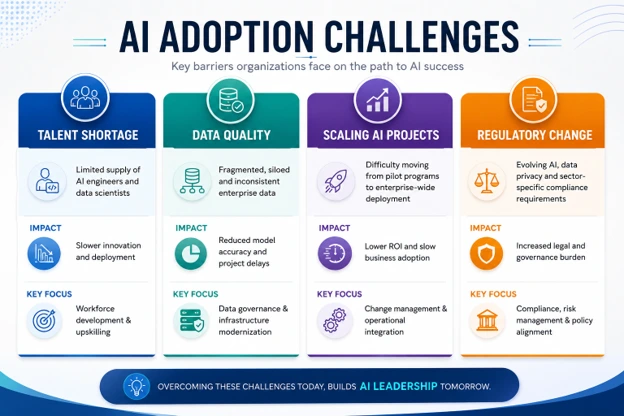
AI adoption is advancing, but significant challenges still stop many projects from scaling beyond pilots.
Talent Shortage: There is a high demand for AI engineers and data scientists, but not enough skilled professionals are available. While universities are helping develop future talent, the shortage remains a challenge today.
Data Quality: AI systems depend on good-quality data. Many companies find that their data is scattered across different systems, poorly organised, or incomplete, making it difficult and time-consuming to prepare for AI use.
Scaling AI Projects: Moving from a successful pilot project to full business-wide implementation is often difficult. Many AI initiatives fail to expand because of organisational and management challenges rather than technical issues.
Changing Regulations: Industries such as healthcare, finance, and law enforcement must keep up with evolving AI and data regulations. Maintaining compliance requires ongoing legal and regulatory oversight.
Frequently Asked Questions
- Which sector is most advanced in AI adoption in the UAE?
Ans. Financial services and energy lead in production-scale deployment. Government services (Dubai in particular) are highly advanced. Healthcare is accelerating rapidly in Abu Dhabi. - What are the biggest barriers to AI adoption in the Middle East?
Ans. Talent gaps, data quality issues, and the challenge of scaling from pilot to enterprise – compounded in regulated sectors by evolving compliance requirements. - How does generative AI fit into the picture?
Ans. It adds a conversational and reasoning layer on top of existing AI deployments – useful for content generation, legal and compliance review, customer service, and analyst productivity. Organisations with strong data foundations and AI-literate teams are best placed to benefit.
Conclusion
The AI transformation across the UAE and Middle East is real, funded, and delivering results. From ADNOC’s drill sites to Emirates NBD’s customer service platforms, from Dubai’s traffic signals to Abu Dhabi’s ICUs, AI is making decisions and improving outcomes at a scale that justifies the investment.
The real impact of AI on UAE and Middle East industries is this: organisations that have moved past experimentation into scaled deployment are outperforming those that haven’t – and the gap is widening every quarter.
The question is no longer whether to adopt AI. It’s how to build the data infrastructure, organisational agility, and talent capability to make AI compounds – turning early gains into a durable competitive advantage. The UAE has shown the region how. The rest is execution.